

Curt Ehrhardt
Kreis Jerichow/Sachsen
1895 -
Schwarz/Hessen
1972
Curt Ehrhardt was born on June 29, 1895 as the son of the teacher and organist Friedrich Otto Ehrhardt in Saxony. In 1916 after his secondary school education in Brandenburg, Ehrhardt began to study jurisprudence in Berlin. That same year Ehrhardt visited the traveling exhibition of the "Sturm" in Berlin, where he first saw works by Picasso, Schwitters and Franz Marc. This exhibitian was a key experience for the artist, which made him get in contact with Herwarth Walden, the manager of the "Sturm" gallery and his circles. Curt Ehrhardt came to the conclusion that he "had to approach painting from new spiritual and social viewpoints", which lead him to terminate his studies and join the "Novembergruppe", which had been founded in 1918.
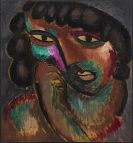
Stylistically, Curt Ehrhart was influenced by the Avant-garde promoted by the "Sturm" group of artists, "Blauer Reiter", Futurism and also Robert Delaunay's Orphism.
In the early 1920s Curt Ehrhardt contributed to prestigious exhibitions including an exhibition of the "Dresdner Sezession" (1919), the "Große Kunstausstellung" in Berlin (1920), the "exhibition of Munich Expressionists" in Chicago (1921) and the "Internationale Kunstausstellung" in Düsseldorf (1922).
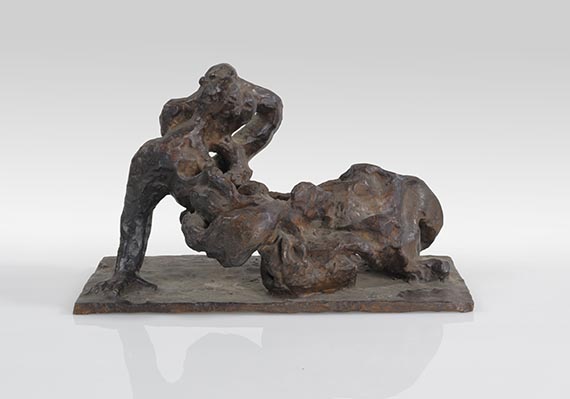
During these years he broke with the Avant-garde painting of the early Expressionism. He produced pointedly colorless works. At the center of Ehrhardt's artistic work is the painful destruction of the human figure, which the artist documented in numerous watercolored sketches. In 1926 the artist left the "Novembergruppe" and continued to work as an independent painter. In spite of the Nazi's defamation of modern art, Ehrhardt continued painting. In 1939 he was drafted to serve in the military. In 1947 he was recognised by the state government of Brandenburg as a "namhaft Schaffender".
In the 1950s Ehrhardt was turned down by the "Verband Bildender Künstler Deutschlands", due to which he was not able to work in public. In order to escape from this inner emigration, Ehrhardt left the German Democratic Republic in 1966 and moved to Schwarz in Hesse, taking almost 2000 works along.
Today important works by Curt Ehrhard can be seen in the "Museum Wiesbaden", at the "Städtische Galerie Darmstadt" and have been bought by the city of Marburg.

Would you like to sell a work by Curt Ehrhardt?
Infos for seller


Starting bid: 4,500 EUR